All Activity
- Past hour
-
 I encountered a comparable experience. I have been a long-term RAC member; however, I did not renew my membership after the complimentary first year of KIA/RAC assistance concluded last year.
 -
 I had consistently been loyal to the RAC and frequently endorsed them, but an incident this year irrevocably altered my perspective. In May, my 12-volt battery discharged completely. I succeeded in entering the vehicle, but that was the extent of my accomplishment—I was unable to secure it. I utilised the application to solicit assistance and received a notification indicating they will contact me once a patrol was located. After some time, I was informed that someone would attend to me in around four hours. Suboptimal, although I was at home rather than stranded. This occurred at approximately 11:30. At 12:45, I received another message indicating they were exceedingly busy and would need to reschedule for the following day, which meant my car would be unlocked on a public road throughout the night. I contacted them to elucidate the issue and was informed that they will assess the matter and respond within the hour. No one made a call. Upon my subsequent contact, they acknowledged the receipt of my call but indicated that no action had been taken. In a state of despair, I resorted to Green Flag. They were unable to provide a specific time but indicated that assistance was available. At approximately 15:00, I received a message indicating that a technician will endeavour to come by 16:30. Thirty minutes later, I received a call from him indicating he would arrive in twenty minutes. He arrived punctually, and within ten minutes, my automobile was operational once more.
 -

Renewal of KIA Roadside Assistance Breakdown Coverage - Avoid It
KWILB replied to DreamCatcher88's topic in General Car Chat
I possess the identical RAC policy as mentioned above, costing £23 per annum with a £40 call-out fee. They offer an additional tyre replacement coverage for £36 annually, which provides up to £150 per tyre for a maximum of five claims per year. convenient for individuals, such as me, lacking a spare tyre. I believe that £59 annually is a reasonable cost, and it has been noted that even with two £40 call-out fees in a year, it amounts to only a slight increase over the Kia pricing, with tyre coverage included as well. -
 Concur - Even in the improbable scenario of incurring the excess for two callouts within the year, it would still be more advantageous to forgo the Kia plan.
 -
 While there is a £40 excess, it is improbable that you will want their services.
 -
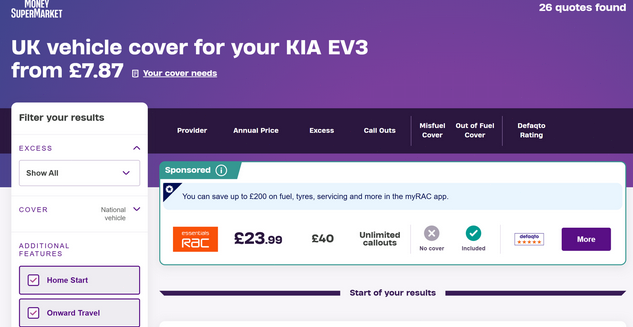
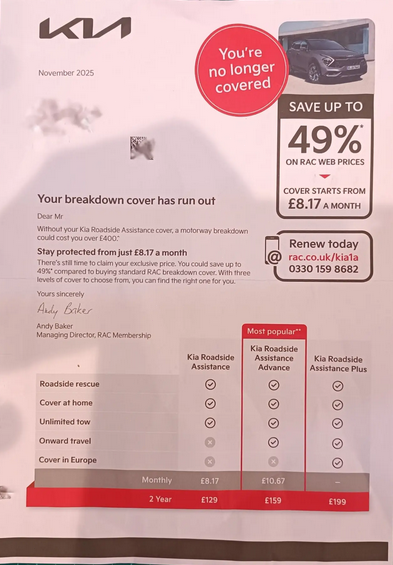
I have possessed my EV3 for somewhat more than a year and have received correspondence from Kia Roadside Assistance—managed exclusively by the RAC—regarding the renewal of my coverage at a 'Special' rate of £10.67 per month, totalling £128 annually. A brief inquiry on MoneySuperMarket for comparable breakdown coverage yielded intriguing results. Letter of Renewal The most economical yearly like-for-like coverage commences at £7.87 per year, whereas RAC annual coverage is priced at £23.99. I choose the RAC for £23.99. If European Breakdown cover was required, it incurred an additional cost of £60. Thank you, but I decline Kia Roadside Assistance; I will obtain equivalent coverage directly from the RAC and save £104 in the process.
- Yesterday
-

FSD 12.5.2 on Hardware 4 Experiences Reduced Performance
Psychil replied to Treeri's topic in General Car Chat
My 2023 Model Y exhibits the similar behaviour in Autopilot with Autosteer. A curve in the road features a vehicle positioned in the centre median, yet not within the travel lanes, occasionally for reasons I cannot discern. The absence of a straightforward "resume" also frustrates me. -

FSD 12.5.2 on Hardware 4 Experiences Reduced Performance
Flexfer replied to Treeri's topic in General Car Chat
It is analogous to seeing a physician and stating, "My arm experiences pain when I perform this action," to which the physician responds, "Refrain from doing that." -

FSD 12.5.2 on Hardware 4 Experiences Reduced Performance
torque2me replied to Treeri's topic in General Car Chat
I consistently appreciate words of this nature. In actuality, the Speed Limit denotes the maximum permissible speed rather than the anticipated driving velocity. Speed regulation has been a concern since the implementation of ASSO around six months ago. Widely recognised problem with numerous discussions addressing it. Simply use the accelerator to increase speed. -

FSD 12.5.2 on Hardware 4 Experiences Reduced Performance
VVC-Geeza replied to Treeri's topic in General Car Chat
Reduce speed; nonetheless, the vehicles are not achieving the designated speed restriction. -
FSD 12.5.2 on Hardware 4 Experiences Reduced Performance
torque2me replied to Treeri's topic in General Car Chat
That indeed appears to align with the recommended approach: to proceed cautiously on corners and in congested traffic. -

FSD 12.5.2 on Hardware 4 Experiences Reduced Performance
stevenkeyte replied to Treeri's topic in General Car Chat
Identical situation with my Model S from November 2016, equipped with version 12.3.6 of Full Self-Driving. It did not occur prior to the most recent update, which was several months ago. Frustration... -

FSD 12.5.2 on Hardware 4 Experiences Reduced Performance
HOV replied to Treeri's topic in General Car Chat
My M3 Performance is exhibiting the same issue. -
The Full Self-Driving (FSD) feature on my Model Y decelerates in heavy traffic or at corners and fails to regain the predetermined speed once the traffic dissipates or upon entering a higher speed limit zone. This is somewhat frustrating on the highway, as it gradually decelerates to approximately 52 mph despite being set to a maximum of 59 mph. Drivers behind me must question what is amiss with me. This is a fundamental function of adaptive cruise control that operates as expected in all other vehicles I have owned, for which I did not incur monthly fees. What is the utility of the lane-keeping feature if the vehicle consistently irritates other drivers by often decelerating? Anticipating a prompt update.
- Last week
-
 Merely a BD Original (TM) Slim. By now, you should be sufficiently acquainted with my aesthetic! It comprises content that is partially distributed among numerous MBClub discussions and posts, many of which I have contributed to, all consolidated in a single location. I recently initiated a comparable thread on tyre skip, having observed its increasing mention in recent posts, with the expectation of further discussions to follow. I proposed that instead of each individual responding to every new thread with identical information, I (and others) may respond to new threads by providing a link.
 -
Is AI streamlined? 😄
-
 You will be culpable as accused. I will retrieve my coat.
 -
If I am banned now, I will understand the reason. 😊
-
 An excellent guide; this should be pinned at the top of the forum! I utilised the 'report' tool to notify the administrators and request that it be designated as a sticky at the top. The report button can have both beneficial and detrimental purposes.
 -
I engaged in this practice with all my Mercedes vehicles. Despite the installation of new batteries. Brief excursions deplete batteries.
-
 Prudent and prompt counsel.
 -
The season is approaching when individuals will begin to share articles regarding their vehicles' difficulties in starting, or their complete failure to start, along with enquiries seeking assistance to diagnose elements that have ceased functioning despite the absence of an apparent defect. Owners frequently report problems that occur abruptly, noting that the vehicle functioned properly during its last use. Posts frequently assert that the lights were not inadvertently left on, that the vehicle is utilised routinely, and/or that a new battery was installed only last year, therefore ruling out these potential causes. All could stem from a malfunction, although in numerous instances, it is merely insufficient battery voltage. This occurs when we extract more energy from the battery than we replenish. The vehicle's alternator replenishes the battery while the engine operates; however, this may be insufficient to prevent a gradual decline in voltage over time. Evenings are darkening sooner, mornings are remaining dark longer, travel durations are diminishing, congestion is intensifying, and our consumption of appliances—such as heaters, heated seats, lights, wipers, and air conditioning—is escalating. This indicates that the vehicle consumes a greater amount of battery charge each minute of operation, while the alternator replenishes the battery for a reduced duration. For certain vehicles, these symptoms will appear very rapidly after the onset of autumn or winter weather. For some, the battery endures throughout autumn and winter, although not sufficiently to allow the natural seasonal transition and usage to replenish more charge than it depletes. Certain contemporary vehicles may deactivate non-essential services and features to safeguard the battery, often without any notification. Certain components exhibit high sensitivity to voltage, resulting in malfunction when the voltage is insufficient, although this may not be intentional. Main dealers, workshops, and motor factors frequently provide a new battery in such situations. If low voltage was the cause, absent any specific defects, this will alleviate symptoms in the short to medium term. However, if the vehicle continues to be utilised in the same manner, the voltage will progressively diminish once more, and the cycle will recur. Replacing the battery prematurely is both costly and unnecessary for the owner or driver, unless the battery is genuinely defective or sufficiently aged to fail in retaining a charge for a reasonable duration, thereby wasting valuable materials and energy involved in its production and distribution. Regularly charging the battery can prevent the voltage from dropping to critically low levels, hence preserving the car's functionalities and its ability to start. The process is swift and uncomplicated, and the battery may remain in the vehicle provided you possess a suitable battery charger (or "maintainer"). A mere 24-hour charge in a month will sufficiently replenish a battery, significantly mitigating the danger of low voltage problems and extending the battery's lifespan. It need not be a continuous 24-hour period and can be conducted anywhere with access to electricity, not exclusively at home. Prominent brands of battery chargers include CTEK, NOCO, and RING, along with those frequently available in the central aisles of Aldi and Lidl, which are highly esteemed. All are sufficiently adequate for infrequent use. Ensure that the charger you purchase is safe for use while the battery remains connected to the vehicle and is compatible with your car's battery type. If your vehicle is equipped with a lithium battery, it must exclusively be charged using a specialised lithium battery charger. These components are exceedingly rare and utilised exclusively in high-performance vehicles, where the substantial relative expense is warranted by the little weight. In case of uncertainty, consult the label on your battery. Ultimately, establishing a connection is uncomplicated. To charge occasionally, attach the charger’s crocodile clips to the jump start terminals located under the hood (see to your vehicle’s manual for exact instructions). Some chargers are equipped with quick-release wires that can be permanently attached for regular charging. Avoid directly attaching the charger to the battery's positive and negative terminals, since this may disrupt the vehicle's charging system and circumvent the protective mechanisms implemented by manufacturers to safeguard the car's delicate electronics.
-
This capability is unavailable in Europe, likely due to legal constraints. In other markets, it is included in Mazda's Connected Services.